tqdm (Python)

tqdm means “progress” in Arabic (taqadum, تقدّم) and is an abbreviation for “I love you so much” in Spanish (te quiero demasiado). Instantly make your loops show a smart progress meter – just wrap any iterable with tqdm(iterable), and you’re done! from tqdm import tqdm for i in tqdm(range(10000)): … 76%|████████████████████████████ | 7568/10000 [00:33 […]
Use rust code in Python with pyo3

Calling Rust code from Python is made easy by PyO3. You can write a Rust library and rely on the combination of PyO3 and maturin, a supporting tool from the PyO3 ecosystem, to compile the Rust library and have it installed directly as a Python module. Among others, PyO3 can translate types between Python and […]
Ruby vs. Python comes down to the for loop

So much of how Ruby and Python differ comes down to the for loop. Python embraces for. Objects tell for how to work with them, and the for loop’s body processes what’s given back by the object. Ruby does the opposite. In Ruby, for itself (via each) is a method of the Object. The caller […]
Ask HN: How did Python become the lingua franca of ML/AI?

Ask HN: How did Python become the lingua franca of ML/AI? 26 points by heyzk 1 hour ago | hide | past | favorite | 17 comments I’ve looked around a bit and can’t really find a satisfying answer to this question. There are posts on answer sites, but these often boil down to “dynamic languages […]
Why Python needs to be paused during profiling – but Ruby doesn’t always
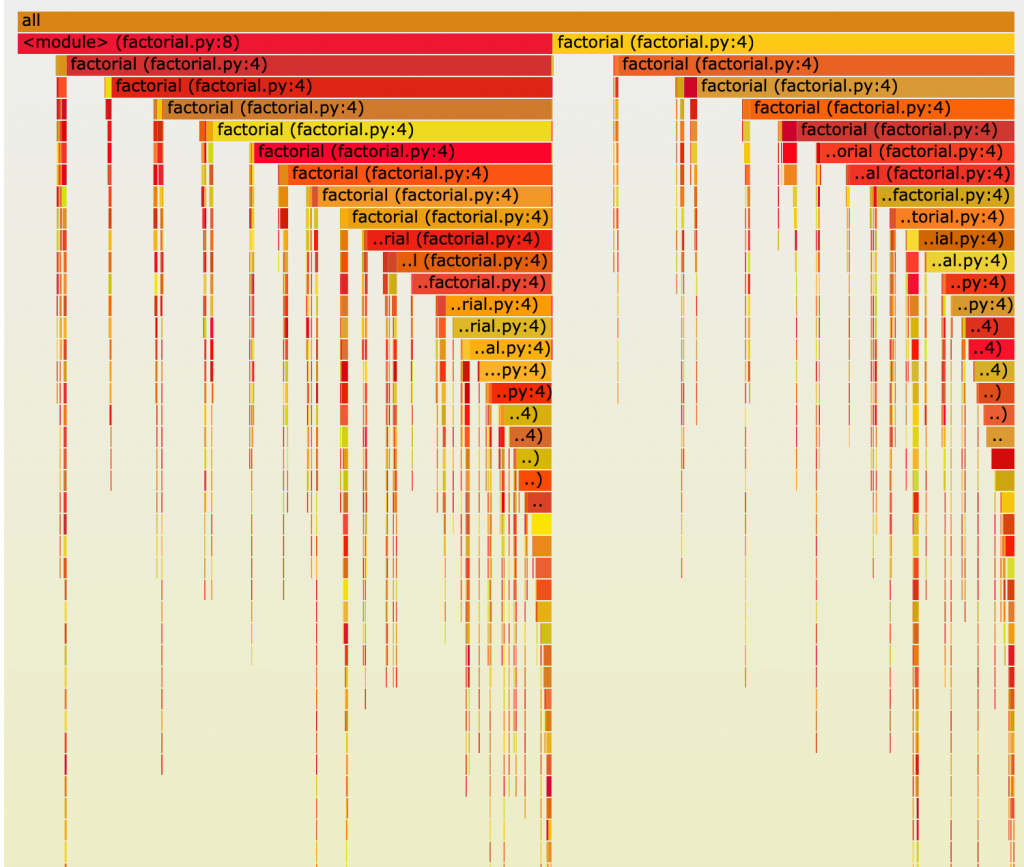
One of the cool things about the rbspy profiler is that it can profile any running Ruby program, without even pausing the Ruby program that is being profiled. Rbspy is a sampling profiler, and when the –nonblocking argument is passed to it, it will collect each stack trace from the profiled program without pausing it […]
Python interpreter written in rust reaches 10000 commits
A Python-3 (CPython >= 3.9.0) Interpreter written in Rust 🐍😱🤘. Usage Check out our online demo running on WebAssembly. RustPython requires Rust latest stable version (e.g 1.43.0 at May 24th 2020). To check Rust version: rustc –version If you wish to update, rustup update stable. To build RustPython locally, do the following: $ git clone […]
Notes from the Meeting on Python GIL Removal Between Python Core and Sam Gross

2021-10-25 12:30:00 During the annual Python core development sprint we held a meeting with Sam Gross, the author of nogil, a fork of Python 3.9 that removes the GIL. This is a non-linear summary of the meeting. tl;dr Sam’s work demonstrates it’s viable to remove the GIL in such a way that the resulting Python […]
Python stands to lose its GIL, and gain a lot of speed

One of Python’s long-standing weaknesses, its inability to scale well in multithreaded environments, is the target of a new proposal among the core developers of the popular programming language. Developer Sam Gross has proposed a major change to the Global Interpreter Lock, or GIL—a key component in CPython, the reference implementation of Python. [ Also on InfoWorld: […]
Python behind the scenes #13: the GIL and its effects on Python multithreading
Published: Wed 22 September 2021 By Victor Skvortsov tags: Python behind the scenes Python CPython As you probably know, the GIL stands for the Global Interpreter Lock, and its job is to make the CPython interpreter thread-safe. The GIL allows only one OS thread to execute Python bytecode at any given time, and the consequence […]
Why I Use Nim instead of Python for Data Processing
Lazy programmers often prefer to substitute computing effort for programming effort. I am just such a programmer. For my research, I often need to design and run algorithms over large datasets ranging into the scale of terabytes. As a fellow at the NIH, I have access to Biowulf, a 100,000+ processor cluster, so it’s usually […]